
Glean Meaning in the Bible: Definition & Verse Examples
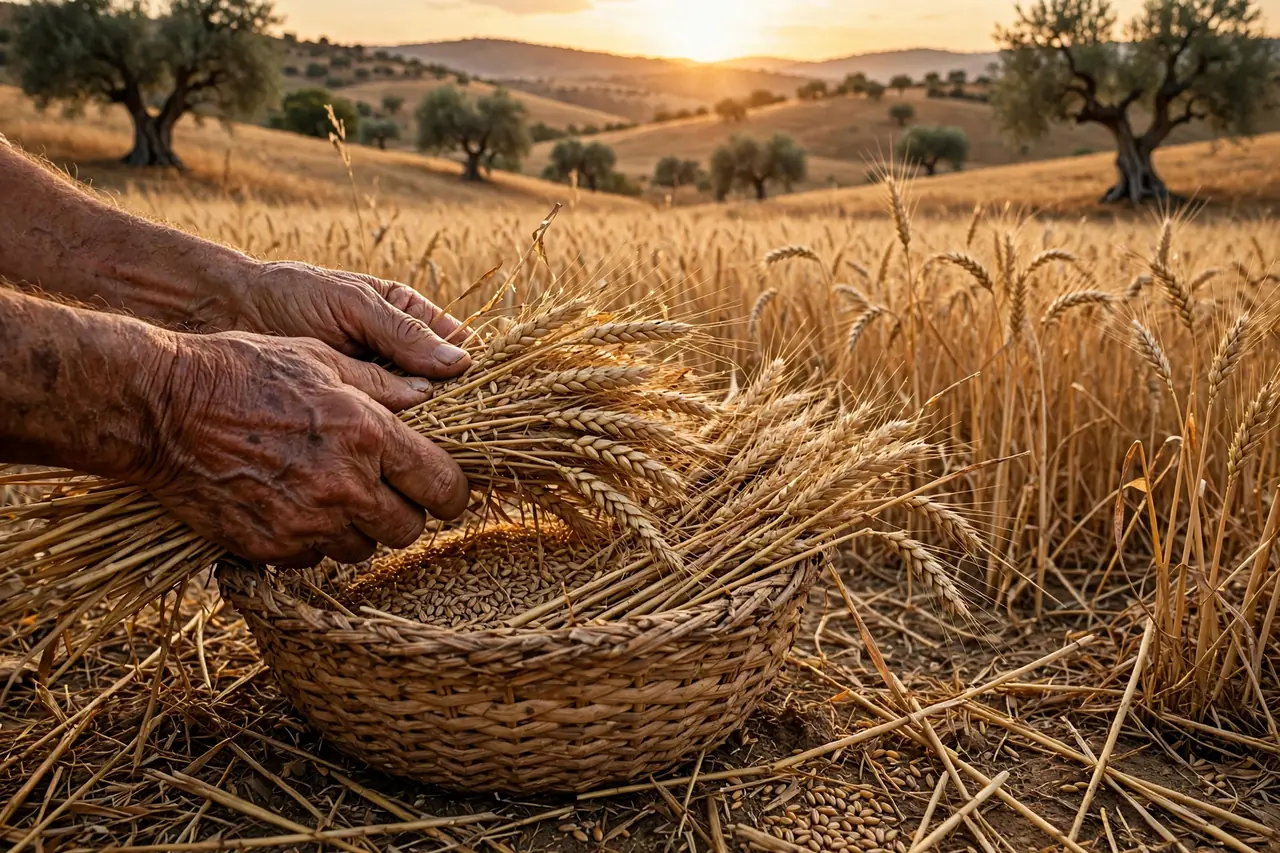
“Glean” in the Bible means to gather the leftover crops that harvest workers leave behind in a field. God’s law told farmers not to pick their fields clean, so that poor people, widows, orphans, and foreigners could come and glean food for themselves. It was one of God’s ways of caring for people in need.
The best-known gleaner in the Bible is Ruth, who gleaned barley in the field of Boaz. In this article, we explain what gleaning means, why God commanded it, the key verses, and the lessons it still teaches today.
What Does “Glean” Mean in Simple Words?
To glean means to pick up what is left over. In Bible times, it worked like this:
- Workers cut the grain in a field during harvest.
- Some stalks were dropped, missed, or left in the corners.
- Poor people came behind the workers and gathered these leftovers.
- They used what they gathered to make food for their families.
So gleaning was gathering the extra bits after the main harvest was done.
What Is the Hebrew Meaning of Glean?
The main Hebrew word for glean is “laqat.” It means:
- To pick up
- To gather
- To collect bit by bit
This word gives a clear picture. Gleaning was slow, careful work. A gleaner would walk through the field, bending down again and again to pick up single stalks of grain.
What Did God’s Law Say About Gleaning?
God gave clear rules about gleaning in the Law of Moses. These rules made sure poor people would always have a way to get food.
Leviticus 19:9-10
“And when ye reap the harvest of your land, thou shalt not wholly reap the corners of thy field, neither shalt thou gather the gleanings of thy harvest. And thou shalt not glean thy vineyard, neither shalt thou gather every grape of thy vineyard; thou shalt leave them for the poor and stranger: I am the LORD your God.” (KJV)
Deuteronomy 24:19
“When thou cuttest down thine harvest in thy field, and hast forgot a sheaf in the field, thou shalt not go again to fetch it: it shall be for the stranger, for the fatherless, and for the widow: that the LORD thy God may bless thee in all the work of thine hands.” (KJV)
Here is a simple summary of the gleaning laws:
| Rule | What Farmers Had to Do | Verse |
| Corners of the field | Leave the edges unharvested | Leviticus 19:9; 23:22 |
| Dropped grain | Not go back to pick it up | Leviticus 19:9 |
| Forgotten sheaves | Leave any bundle they forgot | Deuteronomy 24:19 |
| Olive trees | Beat the branches only once | Deuteronomy 24:20 |
| Vineyards | Not pick every last grape | Leviticus 19:10; Deuteronomy 24:21 |
Who Was Allowed to Glean in the Bible?
God’s law named four groups of people who could glean:
- The poor – people without enough money or land
- Widows – women whose husbands had died
- The fatherless – orphans with no father to provide for them
- Strangers – foreigners living in Israel who had no land of their own
These were the people most likely to go hungry in that time. Gleaning gave them a way to eat without begging. They worked for their food, which gave them dignity.
Why Did God Command Gleaning?
God had several good reasons for this law:
- To feed the poor. It was a simple, daily way to make sure no one starved.
- To protect dignity. People in need could work for their food instead of just receiving handouts.
- To teach generosity. Farmers learned to hold their harvest with an open hand.
- To remind Israel of God’s goodness. The land and its crops really belonged to God.
- To bring blessing. Deuteronomy 24:19 says God would bless the farmer who obeyed.
Deuteronomy 24:22 also gave a reason to remember: “thou shalt remember that thou wast a bondman in the land of Egypt.” Israel had once been poor and enslaved. Now they were to show kindness to others.
What Is the Story of Ruth Gleaning?
The book of Ruth gives the clearest picture of gleaning in action.
Ruth Goes to Glean
Ruth was a widow from the land of Moab. After her husband died, she chose to stay with her mother-in-law, Naomi, and move to Bethlehem. The two women were poor and had no one to provide for them.
“And Ruth the Moabitess said unto Naomi, Let me now go to the field, and glean ears of corn after him in whose sight I shall find grace.” (Ruth 2:2, KJV)
Note: In the KJV, “corn” means grain in general, not the corn we know today. In Ruth’s story, it was mainly barley.
Ruth Meets Boaz
Ruth ended up in a field owned by Boaz, a relative of Naomi’s husband. Boaz noticed Ruth and was kind to her. He told her to stay in his field and drink from his water jars. He even told his workers to help her:
“Let her glean even among the sheaves, and reproach her not: And let fall also some of the handfuls of purpose for her, and leave them, that she may glean them, and rebuke her not.” (Ruth 2:15-16, KJV)
Boaz went beyond what the law required. He let Ruth glean closer to the main harvest, and he told his men to drop extra grain on purpose for her.
How Much Did Ruth Glean?
“So she gleaned in the field until even, and beat out that she had gleaned: and it was about an ephah of barley.” (Ruth 2:17, KJV)
An ephah was a large amount, likely enough grain to feed Ruth and Naomi for a good while. This showed how generous Boaz had been.
How Did the Story End?
Boaz later married Ruth. They had a son named Obed, who became the grandfather of King David. And through David’s family line came Jesus (Matthew 1:5-6). A poor widow who gleaned in a field became part of the most important family line in history.
What Is the Spiritual Meaning of Gleaning?
Gleaning carries some rich spiritual lessons:
- God cares for the poor. His law built kindness right into the way farmers worked.
- God provides. Even when we have little, He makes a way.
- Humble work is honored. Ruth was not ashamed to glean, and God blessed her.
- Generosity brings blessing. Boaz gave more than he had to, and his life became part of God’s great plan.
- Grace goes beyond the rules. Boaz showed grace, much like God shows us more kindness than we deserve.
Many Christians also see Boaz as a picture of Jesus. Boaz was a “kinsman redeemer” who rescued Ruth. In the same way, Jesus rescues and redeems His people.
Where Else Is Gleaning Mentioned in the Bible?
The word also appears in a few other places, often as a picture or comparison:
- Judges 8:2 – Gideon told the men of Ephraim, “Is not the gleaning of the grapes of Ephraim better than the vintage of Abiezer?” He meant that even their small part was better than his whole effort. This calmed their anger.
- Isaiah 17:6 – After judgment, only a few “gleaning grapes” would be left, like two or three olives at the top of a tree. It shows that only a small remnant would remain.
- Jeremiah 6:9 – “They shall throughly glean the remnant of Israel as a vine.” This warned that enemies would strip Israel bare.
- Micah 7:1 – The prophet felt like someone looking for fruit after the harvest was gone, showing how few good people were left.
Did Jesus and His Disciples Glean?
Something similar happened in the Gospels. In Mark 2:23, Jesus’ disciples picked heads of grain as they walked through a field on the Sabbath. This was allowed by God’s law, which let people pick grain by hand from a neighbor’s field to eat (Deuteronomy 23:25). The Pharisees only complained because it was the Sabbath.
What Does “Glean” Mean Today?
Today, “glean” is often used to mean gathering information little by little. For example, “She gleaned a lot from the meeting.”
The idea is the same as in the Bible. Just as gleaners collected grain piece by piece, people today “glean” knowledge one bit at a time.
There are also modern gleaning groups. Some charities collect leftover crops from farms after harvest and give them to food banks. They are following the same idea found in Leviticus.
Frequently Asked Questions
What does glean mean in the Bible?
Glean means to gather leftover grain or crops after the harvest workers are done. It was God’s way of providing for the poor.
Who gleaned in the Bible?
Ruth is the best-known gleaner. She gleaned barley in the field of Boaz to feed herself and Naomi.
What did God say about gleaning?
God told farmers not to harvest the corners of their fields or pick up what was dropped, so the poor and foreigners could gather it (Leviticus 19:9-10).
What is the Hebrew word for glean?
The Hebrew word is “laqat,” which means to pick up or gather bit by bit.
What is the spiritual meaning of gleaning?
It shows God’s care for the poor, the value of humble work, and the blessing that comes from being generous.
What does “glean” mean in modern English?
Today, it usually means to collect information or ideas little by little.
Conclusion
To “glean” in the Bible means to gather leftover crops after the harvest. God built this practice into His law so that the poor, widows, orphans, and foreigners would always have food and dignity. Ruth’s story shows how beautiful this can be. A poor widow gleaned in a kind man’s field, and God used her to bring about the family line of King David and Jesus. Gleaning reminds us that God cares for people in need, and He calls us to be generous too.