Enthroned Meaning in the Bible: Definition & Verse Examples

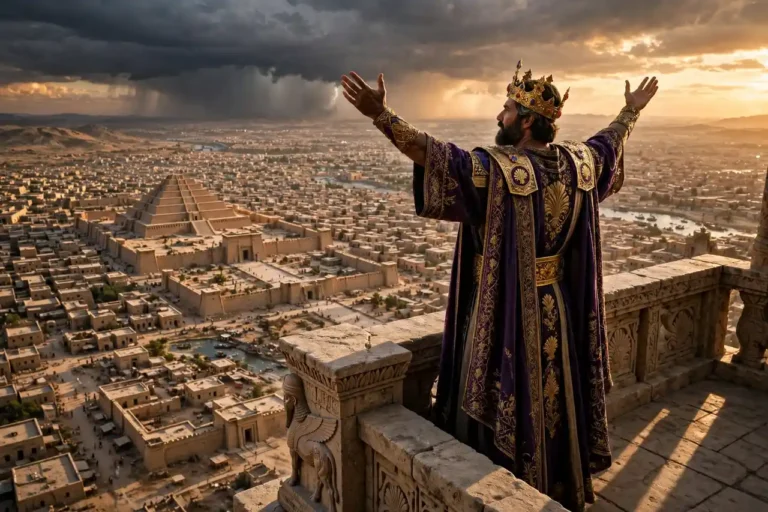
“Enthroned” in the Bible means seated on a throne as king, with full authority to rule. When the Bible says God is “enthroned,” it means He is the King of heaven and earth, reigning over everything. The word paints a picture of God sitting on His royal seat, in control and worthy of honor.
You will find “enthroned” mostly in modern Bibles like the NIV and ESV, especially in the Psalms and Isaiah. The King James Version (KJV) expresses the same idea with words like “sitteth” and “dwelleth.” In this article, we explain what it means, look at the key verses, and answer the popular question of what it means that God is “enthroned on the praises” of His people.
What Does "Enthroned" Mean in Simple Words?
To be enthroned means to be seated on a throne as a ruler. A throne is the special seat of a king or queen. When someone is enthroned, they have officially taken their place of power.
In the Bible, “enthroned” usually describes God and shows:
- His kingship – God is the true King over all
- His authority – He has the right to rule and make decisions
- His majesty – He is glorious and worthy of honor
- His stability – His throne cannot be shaken or taken away
What Is the Hebrew Meaning of Enthroned?
The Hebrew word behind “enthroned” is usually “yashab.” It is a very common word that means:
- To sit
- To dwell or live
- To remain
- To sit as a king or judge
The exact meaning depends on the context. When “yashab” is used of God in a royal setting, such as “sitting” in heaven or above the cherubim, modern translators often render it as “enthroned” to make the meaning clear.
Is "Enthroned" in the King James Bible?
Not as a word. The KJV does not use “enthroned.” Instead, it uses older, simpler words for the same idea:
| Verse | KJV Wording | NIV Wording |
|---|---|---|
| Psalm 2:4 | “He that sitteth in the heavens shall laugh” | “The One enthroned in heaven laughs” |
| Psalm 29:10 | “The LORD sitteth upon the flood” | “The LORD sits enthroned over the flood” |
| Psalm 99:1 | “he sitteth between the cherubims” | “he sits enthroned between the cherubim” |
| Psalm 113:5 | “the LORD our God, who dwelleth on high” | “who sits enthroned on high” |
| Isaiah 40:22 | “It is he that sitteth upon the circle of the earth” | “He sits enthroned above the circle of the earth” |
So when you read “sitteth” or “dwelleth” about God in the KJV, think of a King seated on His throne.
What Does "Enthroned Between the Cherubim" Mean?
Several verses describe God as sitting or “dwelling” between the cherubim:
- 1 Samuel 4:4 – “the ark of the covenant of the LORD of hosts, which dwelleth between the cherubims”
- Psalm 80:1 – “thou that dwellest between the cherubims, shine forth”
- Isaiah 37:16 – King Hezekiah prayed, “O LORD of hosts, God of Israel, that dwellest between the cherubims, thou art the God, even thou alone”
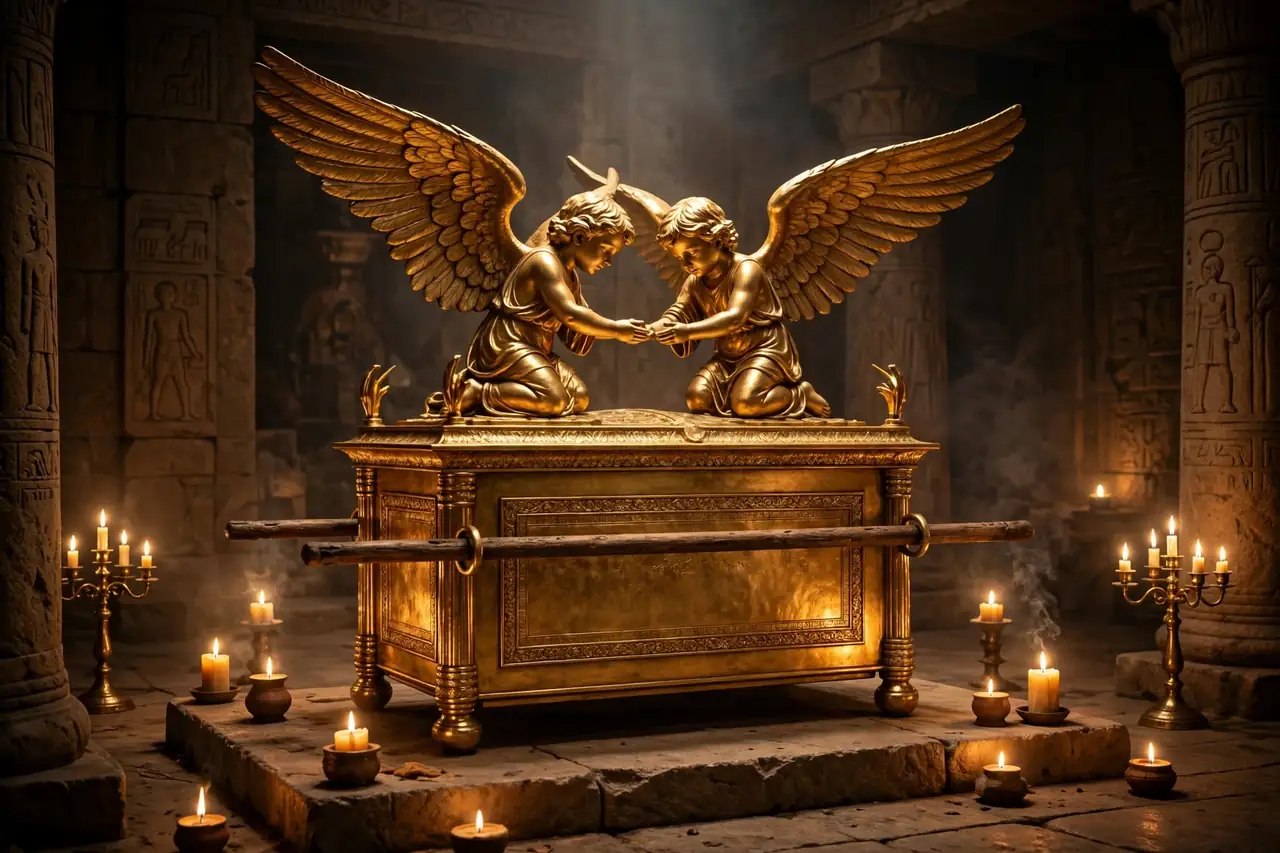
What it means: The ark of the covenant was a golden chest kept in the most holy part of the tabernacle and later the temple. On its lid were two golden cherubim (angel-like figures) with their wings stretched out. The space above the lid between them was seen as the place of God’s throne on earth. King David even called the ark God’s “footstool” (1 Chronicles 28:2).
The ark was only a small picture of something much bigger. God’s true throne is in heaven, and the whole earth is His footstool (Isaiah 66:1).
What Does "Enthroned in Heaven" Mean?
“He that sitteth in the heavens shall laugh: the Lord shall have them in derision.” (Psalm 2:4, KJV)
In Psalm 2, the nations plot against God and His chosen King. But God is not worried. He is enthroned in heaven, far above all their plans. Their rebellion looks small and foolish from His throne.
A few verses later, God announces His King: “Thou art my Son; this day have I begotten thee” (Psalm 2:7). We explain that verse in our guide on begotten meaning in bible.
Other verses say the same thing:
- Psalm 29:10 – “The LORD sitteth upon the flood; yea, the LORD sitteth King for ever.” Even the wildest storm is under His rule.
- Psalm 9:7 – “But the LORD shall endure for ever: he hath prepared his throne for judgment.”
- Isaiah 6:1 – “I saw also the Lord sitting upon a throne, high and lifted up, and his train filled the temple.”
These verses show that God’s rule is forever, above every power, and completely secure. We explore this truth more in our article on sovereign meaning in the bible.

What Does "Enthroned on the Praises of Israel" Mean in Psalm 22:3?
This is one of the most searched verses with this word:
“But thou art holy, O thou that inhabitest the praises of Israel.” (Psalm 22:3, KJV)
The ESV translates it as “Yet you are holy, enthroned on the praises of Israel.” The Hebrew word here is again “yashab,” which can mean “inhabit” or “sit enthroned.”
What it means: God is pictured as sitting on a throne made of His people’s praises. Israel’s worship, built up over generations, is like a royal seat for the holy King.
The setting matters. Psalm 22 begins with the cry, “My God, my God, why hast thou forsaken me?” (Psalm 22:1). David felt alone and in pain, yet he still remembered that God is holy and worthy of praise. Even in the dark, he chose to honor God’s throne.
Does God Live in Our Praise?
Many Christians today say “God inhabits the praises of His people,” based on the KJV wording. They mean that God is especially near when His people worship Him. The Bible supports the idea that God is present with His worshipping people (Matthew 18:20). At the same time, God is always present everywhere (Psalm 139:7-10). Praise does not “bring” God down; rather, it honors the King who is already there.
Is Jesus Enthroned in Heaven?
Yes. The New Testament teaches that after Jesus died and rose again, He was enthroned at the right hand of God the Father.
- Hebrews 1:3 – “when he had by himself purged our sins, sat down on the right hand of the Majesty on high.”
- Hebrews 12:2 – Jesus “for the joy that was set before him endured the cross, despising the shame, and is set down at the right hand of the throne of God.”
- Ephesians 1:20 – God “raised him from the dead, and set him at his own right hand in the heavenly places.”
In the ancient world, the “right hand” of a king was the place of highest honor and power. So when Jesus “sat down,” it showed His work of saving people was complete, and He now rules as King.
Notice the path to the throne in Hebrews 12:2: first the cross, then the crown. Before He was enthroned, Jesus was mocked, beaten, and scourged. We explain that part of His suffering in our article on flogged meaning in the bible.
What Does the Throne in Revelation Show?
The book of Revelation gives a vivid picture of God enthroned in heaven:
“And immediately I was in the spirit: and, behold, a throne was set in heaven, and one sat on the throne.” (Revelation 4:2, KJV)
Around the throne are a rainbow, lightning, angels, and elders who worship day and night, saying, “Holy, holy, holy, Lord God Almighty” (Revelation 4:8). In Revelation 5, the Lamb, Jesus, stands at the center of the throne and receives worship too.
At the very end of the Bible, God’s throne is in the new city, and “his servants shall serve him” (Revelation 22:3).
Will Believers Share Christ's Throne?
The Bible gives an amazing promise:
“To him that overcometh will I grant to sit with me in my throne, even as I also overcame, and am set down with my Father in his throne.” (Revelation 3:21, KJV)
This does not mean believers become God. It means they will share in Christ’s victory and reign with Him (2 Timothy 2:12). It is a picture of great honor given by grace.
What Can We Learn From God Being Enthroned?
- God is in control. No plan of man can overthrow His throne (Psalm 2:4).
- We can pray with confidence. “Let us therefore come boldly unto the throne of grace, that we may obtain mercy” (Hebrews 4:16).
- Worship is fitting. A King deserves honor, and praise is our way of giving it.
- Suffering is not the end. Jesus went from the cross to the throne, and He promises His people a share in His victory.
What Is the Difference Between Enthroned, Crowned, and Reigning?
These words are close, but each shows a different side of being king:
- Crowned – The moment a king receives his crown and is publicly declared king.
- Enthroned – The king takes his seat of power and begins to rule.
- Reigning – The ongoing act of ruling over a kingdom.
The Bible uses all three ideas for God and for Jesus. Hebrews 2:9 says Jesus is “crowned with glory and honour,” Hebrews 12:2 says He “is set down at the right hand of the throne,” and Revelation 11:15 says “he shall reign for ever and ever.”

Frequently Asked Questions
What does enthroned mean in the Bible?
Enthroned means seated on a throne as king. In the Bible, it describes God ruling over heaven and earth with full authority.
What is the Hebrew word for enthroned?
The main Hebrew word is “yashab,” which means to sit or dwell. In royal settings, it is often translated “enthroned.”
What does "enthroned on the praises of Israel" mean?
It comes from Psalm 22:3 and pictures God seated as King on the worship of His people. The KJV says God “inhabitest the praises of Israel.”
What does "enthroned between the cherubim" mean?
It refers to the ark of the covenant, where golden cherubim marked the place of God’s throne among His people.
Is Jesus enthroned now?
Yes. Hebrews 1:3 and 12:2 say Jesus sat down at the right hand of God’s throne after His death and resurrection.
Conclusion
“Enthroned” in the Bible means seated on a throne with royal authority. Modern Bibles use it to describe God as King over the flood, the nations, and all creation, while the KJV says He “sitteth” or “dwelleth” on high. The word reminds us that God is never off His throne, that Jesus now reigns at His right hand, and that His people can come boldly to that “throne of grace” in every season of life.
Related Word Meanings
Keep exploring the King James Bible, one word at a time: