
Foes Meaning in the Bible: Definition & Verse Examples

“Foes” in the Bible means enemies or adversaries, people or forces that stand against someone and want to harm them. In the Psalms, David often cries out to God about his foes, and God promises to protect His people and defeat those who rise against them.
The word appears in well-loved verses like “When the wicked, even mine enemies and my foes, came upon me… they stumbled and fell” (Psalm 27:2). In this article, we explain what “foes” means in simple words, look at the key verses, and share what Jesus taught about how to treat our enemies.
What Does "Foes" Mean in Simple Words?
A foe is an enemy, someone who is against you. Foes can be:
- People who want to hurt you – like armies or personal enemies
- People who oppose God – those who fight against God’s people or His ways
- Spiritual enemies – evil forces that work against believers
- Hard situations – sometimes the word is used for troubles that attack us
The word “foe” comes from Old English and has always meant an enemy or someone hostile. Today it sounds a little old-fashioned, but most people still know it from stories and poems.
Is "Foe" the Same as "Enemy"?
Yes, almost exactly. The Bible often uses “foes” and “enemies” side by side in the same verse, mainly for emphasis. For example:
“When the wicked, even mine enemies and my foes, came upon me to eat up my flesh, they stumbled and fell.” (Psalm 27:2)
Hebrew poetry often repeats an idea with two similar words. This is called parallelism. It makes the point stronger and easier to remember.
What Is the Hebrew and Greek Meaning of Foes?
The KJV translates several original words as “foes”:
| Original Word | Language | Meaning | Example |
|---|---|---|---|
| Tsar | Hebrew | Adversary, someone who narrows or presses in | Psalm 89:23, 1 Chronicles 21:12 |
| Oyeb | Hebrew | Enemy, one who hates | Psalm 27:2, Psalm 30:1 |
| Echthros | Greek | Enemy, someone hostile | Matthew 10:36 |
The Hebrew word “tsar” comes from a root that means “narrow” or “tight.” A foe is someone who presses in on you and makes you feel trapped. That is a good picture of how David often felt when enemies surrounded him.
The Greek word “echthros” is the same word Jesus used when He said, “Love your enemies” (Matthew 5:44).

What Does Psalm 27:2 Say About Foes?
“When the wicked, even mine enemies and my foes, came upon me to eat up my flesh, they stumbled and fell.” (Psalm 27:2, KJV)
Meaning: David describes enemies attacking him like wild animals. But instead of winning, they “stumbled and fell.” God protected him.
The psalm begins with a strong statement of trust: “The LORD is my light and my salvation; whom shall I fear?” (Psalm 27:1). David’s courage did not come from his own strength. It came from knowing who was on his side.
Later in the same psalm, David says, “When my father and my mother forsake me, then the LORD will take me up” (Psalm 27:10). Even if everyone else leaves, God stays. We explain this promise in our article on forsake meaning in the bible.

What Does "Thou Hast Not Made My Foes to Rejoice Over Me" Mean?
“I will extol thee, O LORD; for thou hast lifted me up, and hast not made my foes to rejoice over me.” (Psalm 30:1, KJV)
Meaning: David thanks God for rescuing him so that his enemies could not celebrate his downfall. God lifted him up, like pulling someone out of a deep pit. Psalm 30 is full of joy, including the famous line, “weeping may endure for a night, but joy cometh in the morning” (Psalm 30:5).
What Does Psalm 89:23 Say About Foes?
“And I will beat down his foes before his face, and plague them that hate him.” (Psalm 89:23, KJV)
Meaning: God promised King David that He would defeat David’s enemies. This was part of God’s covenant with David’s family line, which Christians believe points forward to Jesus, the King from David’s line.
God’s power over every enemy shows His supreme rule over all things. We explore this in our guide on sovereign meaning in the bible.
What Does "A Man's Foes Shall Be They of His Own Household" Mean?
“And a man’s foes shall be they of his own household.” (Matthew 10:36, KJV)
Meaning: Jesus warned that following Him might cause conflict even within families. Some family members might reject a person’s faith and turn against them. Jesus was quoting Micah 7:6.
This does not mean Jesus wants families to fight. It is an honest warning that loyalty to Him comes first, even when it is costly.
What Does "In the Presence of Mine Enemies" Mean in Psalm 23:5?
“Thou preparest a table before me in the presence of mine enemies: thou anointest my head with oil; my cup runneth over.” (Psalm 23:5, KJV)
Meaning: God does not always remove our foes right away. Sometimes He blesses us right in front of them. A host preparing a table was a sign of welcome and protection. God takes care of His people even while trouble is still close by.
Why Does David Talk About His Foes So Often?
David faced real enemies for much of his life. King Saul chased him for years, the Philistines fought against Israel, and even his own son Absalom led a rebellion against him (2 Samuel 15).
Instead of hiding his fear and anger, David brought them to God in prayer. The Psalms show us that:
- It is okay to be honest with God about people who hurt us.
- God hears the cries of the oppressed. “The righteous cry, and the LORD heareth, and delivereth them out of all their troubles” (Psalm 34:17).
- Trust replaces fear. Again and again, David moves from “look how many foes I have” to “but thou, O LORD, art a shield for me” (Psalm 3:1-3).
These prayers give us words to use when we face our own foes.
How Does Jesus Tell Us to Treat Our Foes?
Jesus gave one of the most surprising teachings in history:
“But I say unto you, Love your enemies, bless them that curse you, do good to them that hate you, and pray for them which despitefully use you, and persecute you.” (Matthew 5:44, KJV)
This does not mean pretending wrong is right. It means refusing to answer hate with hate. Jesus lived this out on the cross when He prayed for the people who crucified Him: “Father, forgive them; for they know not what they do” (Luke 23:34).
The Bible gives practical steps:
- Pray for them. Ask God to bless and change them (Matthew 5:44).
- Do good to them. “If thine enemy hunger, feed him; if he thirst, give him drink” (Romans 12:20; Proverbs 25:21).
- Leave revenge to God. “Vengeance is mine; I will repay, saith the Lord” (Romans 12:19).
- Overcome evil with good. “Be not overcome of evil, but overcome evil with good” (Romans 12:21).
Who Are Our Spiritual Foes?
The Bible teaches that believers also face unseen enemies:
- The devil – “your adversary the devil, as a roaring lion, walketh about, seeking whom he may devour” (1 Peter 5:8).
- Evil spiritual forces – “we wrestle not against flesh and blood” (Ephesians 6:12).
- Death – “The last enemy that shall be destroyed is death” (1 Corinthians 15:26).
The good news is that Jesus has already won the victory over all of them. Through Him, believers can stand firm and not be afraid.
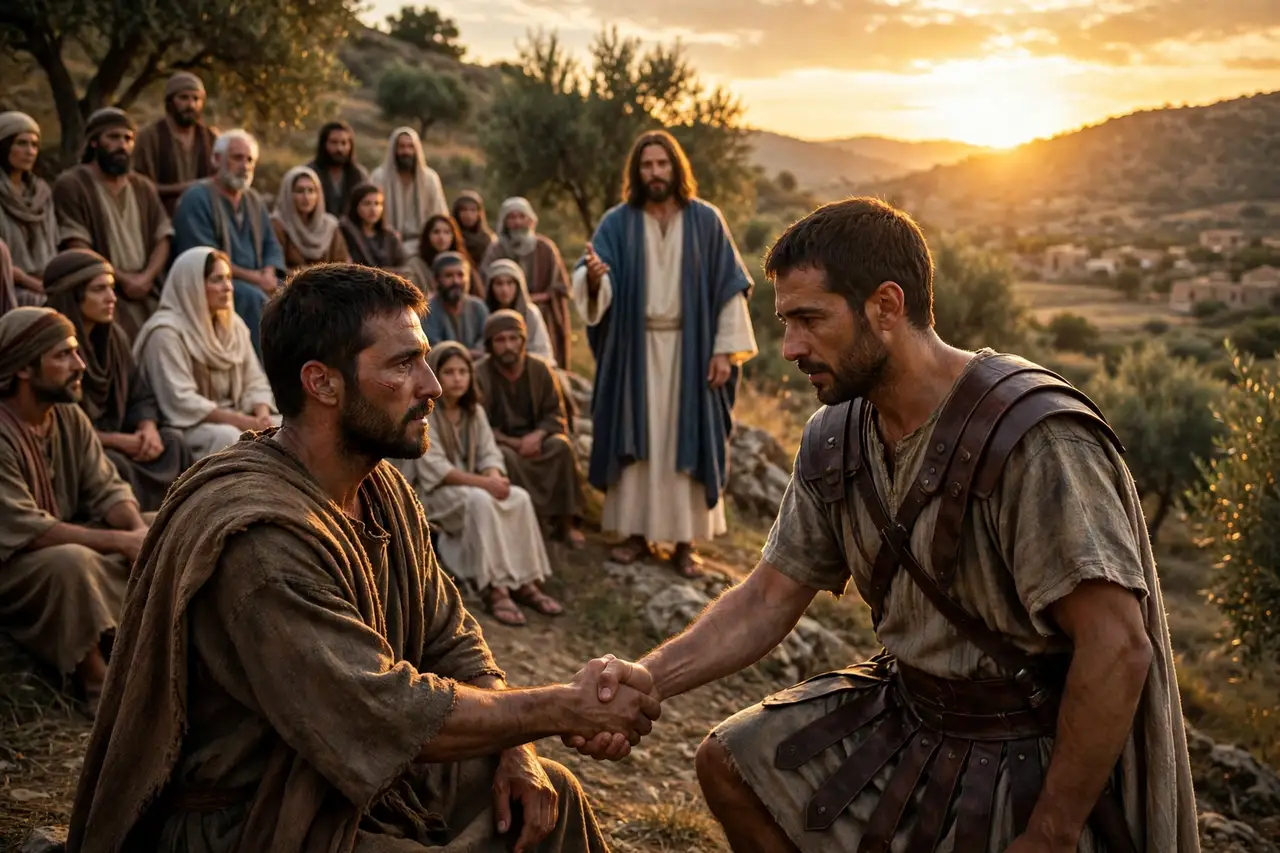
Can Foes Become Friends?
Yes. The Bible tells many stories of enemies who made peace:
- Jacob and Esau were bitter enemies after Jacob stole Esau’s blessing. Years later, Esau ran to meet Jacob, “and fell on his neck, and kissed him: and they wept” (Genesis 33:4).
- Jacob and Laban had a heated argument but ended it with a peace agreement and a pile of stones as a witness (Genesis 31:44-49). We tell that story in our article on chode meaning in the bible.
- Saul of Tarsus hunted Christians, but after meeting Jesus, he became the apostle Paul.
Proverbs 16:7 gives a hopeful promise: “When a man’s ways please the LORD, he maketh even his enemies to be at peace with him.”
Most amazing of all, the Bible says that we ourselves were once God’s foes. “For if, when we were enemies, we were reconciled to God by the death of his Son, much more, being reconciled, we shall be saved by his life” (Romans 5:10). God turned His enemies into His children.
How Do Modern Bibles Translate "Foes"?
Many modern Bibles keep the word “foes” (NIV, ESV) because it is still clear today. Others use “enemies” or “adversaries.” The meaning stays the same.
What Can We Learn About Foes From the Bible?
- God is our protection. “The LORD is my light and my salvation; whom shall I fear?”
- God can bless us even near our enemies. He prepares a table “in the presence of mine enemies.”
- Love your enemies. Jesus calls us to answer hate with love and prayer.
- Leave revenge to God. He is a fair judge.
- Peace is possible. God can turn foes into friends.
Frequently Asked Questions
What does foes mean in the Bible?
Foes means enemies or adversaries, people or forces that stand against someone and want to harm them.
Is foe the same as enemy in the Bible?
Yes. The Bible often uses “foes” and “enemies” together for emphasis, as in Psalm 27:2.
What does "a man's foes shall be they of his own household" mean?
Jesus warned in Matthew 10:36 that following Him might cause conflict even with family members who reject Him.
What does the Bible say about loving your foes?
Jesus said, “Love your enemies… pray for them which despitefully use you” (Matthew 5:44). Believers are called to answer hate with love.
Who is the believer's greatest foe?
The Bible names the devil as our adversary (1 Peter 5:8) and death as “the last enemy” (1 Corinthians 15:26). Jesus has defeated both.
Conclusion
“Foes” in the Bible means enemies, those who stand against God’s people. The Psalms show David bringing his foes to God and trusting Him for protection, and God promises to stand with His people. Jesus adds a surprising call: love your enemies, pray for them, and overcome evil with good. Best of all, the Bible shows that God can turn foes into friends, just as He reconciled us to Himself through His Son.
Related Word Meanings
Keep exploring the King James Bible, one word at a time: